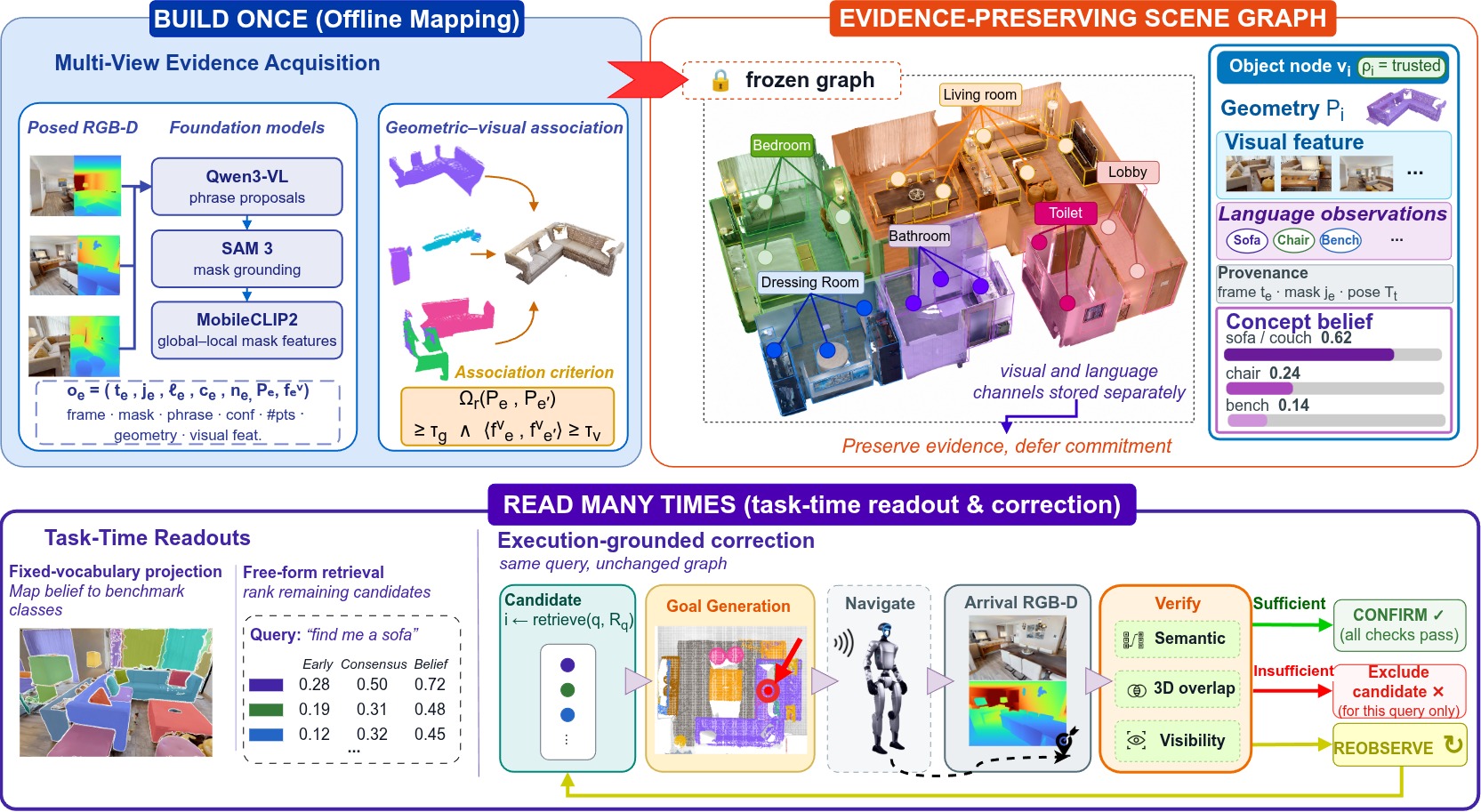
OpenBelief-Nav is a training-free open-vocabulary scene graph for language-guided robot navigation. Each object node preserves its multi-view phrases, reliability weights, and exact provenance instead of a single committed label — so segmentation, retrieval, and execution-time correction all become task-time readouts over one frozen graph.
A sofa seen from four viewpoints may be proposed as sofa, chair, bench, or armchair — occlusion, scale, and foundation-model noise guarantee disagreement. ConceptGraphs, HOV-SG, FSR-VLN, and DualMap all resolve that disagreement at construction time, exposing each object as one fused feature, label, or consensus state. Related approaches push on adjacent axes without changing this pattern: ConceptFusion and VLMaps embed features densely rather than per object, and OGScene3D and ThinkGraphs refine tracking and confidence while still exposing a single committed state per object. Three things go wrong.
When a majority vote picks one label, the minority phrases are gone. Yet among nodes misclassified by majority vote, the correct category is often still present in the stored phrase set — information the system already paid to acquire, discarded by how it is stored.
The readout that maximizes benchmark segmentation is not the one that maximizes navigation success — our experiments show full-belief projection wins segmentation while a consensus readout wins retrieval. A map that commits to either loses the other.
The top-ranked node can be a distractor, or an instance the arrival observation can't confirm. Retrieval alone can't tell the difference — the robot has to verify the selected binding physically before treating it as ground truth.
An object node stores the evidence-preserving state \(\mathcal{B}_i = (P_i, \mathbf{f}_i^v, \mathcal{O}_i, \mathbf{V}_i, \mathbf{p}_i, \mathbf{f}_i^t, \rho_i)\) — point cloud, aggregate visual feature, the raw language observations, concept-level evidence with its smoothed belief, a consensus text feature, and a trust status. The visual and language channels are never destructively fused during mapping; every cross-modal decision is deferred to a readout.
A frozen VLM proposes phrases; a promptable segmenter grounds each phrase as masks. Every mask is kept as an observation with its phrase, confidence, 3D point cloud, visual feature, and exact frame + mask provenance.
Observations merge on 3D overlap, with visual similarity only as a rejection cue — never on predicted names. Precision is favored: a false merge is irreversible, a missed one is recoverable at query time.
Observations are weighted by what we actually know — segmentation confidence and 3D support — grouped into synonym-aware concepts \(V_{ik}\), and Dirichlet-smoothed so sparse evidence can't fake certainty.
Vocabulary projection and free-form retrieval are separate operators over the same frozen evidence — and at deployment, arrival observations physically test the selected hypothesis.
Five views of the same sofa arrive with different phrases. Play the stream, then toggle synonym consolidation off: the lexical variants sofa / couch / loveseat split their votes and a single high-support chair observation wins. Drag α to see Dirichlet smoothing keep sparse evidence from collapsing into false certainty.
Because a node stores evidence rather than a decision, the same frozen graph answers differently — and correctly — for each task.
The benchmark vocabulary arrives only at evaluation time. The stored belief \(p_{ik}\) is visually refined into \(\widetilde{p}_{ik}\) within its existing support, then projected onto target class distribution \(\widehat{p}_i(c)\) — secondary hypotheses an early top-1 would have discarded remain recoverable.
Query similarity fuses the visual and language heads \(H_i^{(r)}(q)\) — but the fusion weight \(\lambda_i\) is per-node, conditioned on the trust status \(\rho_i\) produced during belief construction:
| no language evidence (\(K_i=0\)) | trust vision only | \(\lambda_i = 1.0\) |
| degraded belief (\(\rho_i = \text{degraded}\)) | lean visual | \(\lambda_i = 0.7\) |
| trusted belief (\(\rho_i = \text{trusted}\)) | trust the text head | \(\lambda_i = 0.2\) |
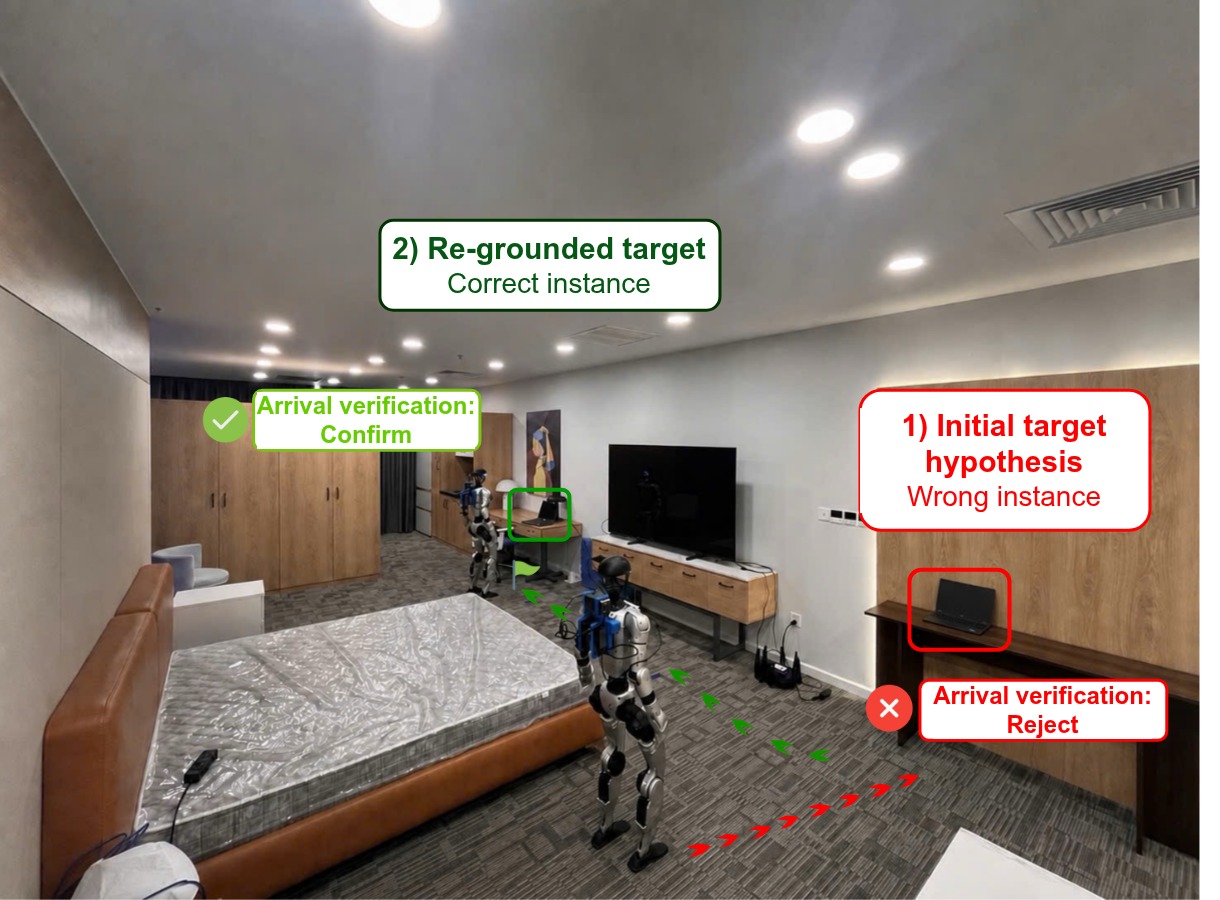
A retrieval result is a hypothesis, not a fact. On arrival, the robot's RGB-D observation runs an ordered verifier — re-observe if the candidate isn't sufficiently visible (absence of view is not evidence of absence), reject on semantic mismatch or on a semantic match that fails to coincide geometrically with the stored node, confirm otherwise. Rejection changes exactly one thing: a per-query exclusion set \(\mathcal{R}_q^{(k+1)} = \mathcal{R}_q^{(k)} \cup \{i^{(k)}\}\). The graph is never modified and the query is never rewritten.
Graph construction is performed once per environment; every number below is a readout over that frozen graph, with no re-perception between tasks.
ScanNet200 (5 scenes) and Replica (8 scenes). Higher is better; bold = best per dataset.
| Method | mIoU ↑ | F-mIoU ↑ | mAcc ↑ |
|---|---|---|---|
| ScanNet200 | |||
| ConceptGraphs | 0.3077 | 0.3538 | |
| HOV-SG | 0.3381 | 0.3714 | |
| DualMap | 0.3288 | 0.3794 | |
| OpenBelief-Nav consensus | 0.4887 | 0.4580 | |
| OpenBelief-Nav full-belief | 0.5276 | 0.4685 | |
| Replica | |||
| ConceptGraphs | 0.3858 | 0.3559 | |
| HOV-SG | 0.4846 | 0.3835 | |
| DualMap | 0.5207 | 0.4024 | |
| OpenBelief-Nav consensus | 0.4647 | 0.4774 | |
| OpenBelief-Nav full-belief | 0.5204 | 0.4822 | |
SR@1m (%), 78 trials per method following the DualMap protocol. Internal readouts share one graph.
| Method | 00829 | 00848 | 00880 | Avg. SR@1m ↑ |
|---|---|---|---|---|
| ConceptGraphs | 69.2 | 53.8 | 61.5 | |
| HOV-SG | 53.8 | 46.2 | 57.7 | |
| DualMap | 73.1 | 69.2 | 69.2 | |
| OpenBelief-Nav consensus | 80.8 | 76.9 | 73.1 | |
| OpenBelief-Nav early-commit | 84.6 | 73.1 | 73.1 | |
| OpenBelief-Nav belief-weighted | 76.9 | 73.1 | 73.1 |
Same object geometry and observations, scored by four different readouts. Higher is better; bold = best per dataset.
| Semantic readout | mIoU ↑ |
|---|---|
| ScanNet200 | |
| Visual-only | 0.1286 |
| Consensus-only | 0.2107 |
| Early-commit | 0.2393 |
| Full-belief projection | 0.2742 |
| Replica | |
| Visual-only | 0.2287 |
| Consensus-only | 0.2831 |
| Early-commit | 0.2701 |
| Full-belief projection | 0.2912 |
Each row disables one mechanism of the belief construction.
| Variant | ScanNet200 mIoU | Nav SR@1m | YCB SR@1m |
|---|---|---|---|
| \(w_e = 1\) (no reliability) | 0.2010 | 70.5 | 55.6 |
| \(w_e = c_e \cdot n_e\) (linear support) | 0.2117 | 74.4 | 50.0 |
| no synonym consolidation | 0.2067 | 75.6 | 61.1 |
| no low-evidence regularization | 0.2095 | 70.5 | 50.0 |
| Default belief construction | 0.2107 | 76.9 | 61.1 |
“Evidence @ query” = per-observation evidence exposed to task-time readouts.
| System | Evidence @ query | Exec. correction |
|---|---|---|
| ConceptGraphs | — | — |
| HOV-SG | — | — |
| FSR-VLN | — | — |
| DualMap | — | ✓ |
| OpenBelief-Nav | ✓ | ✓ |
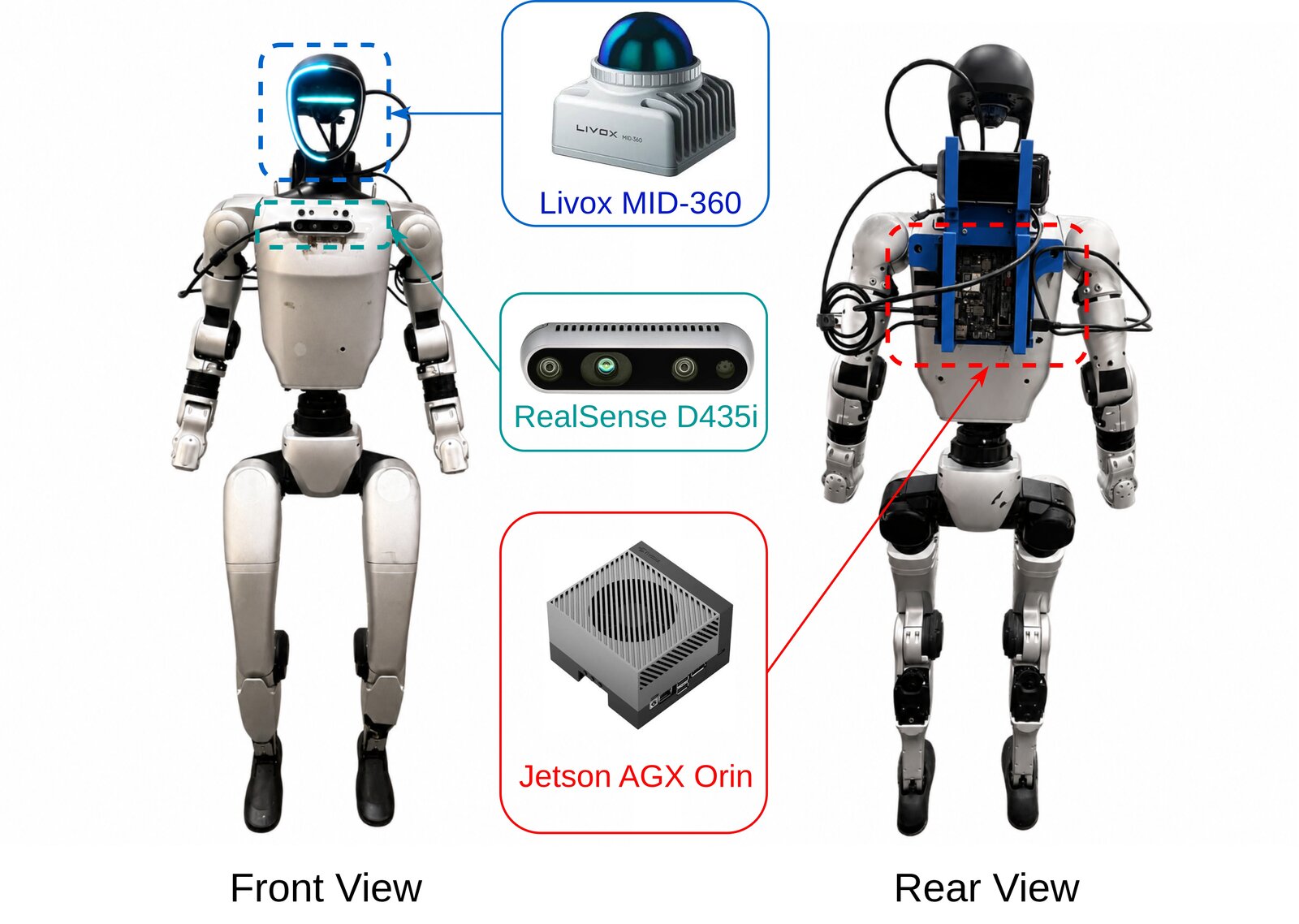
Compute-heavy semantic reasoning runs offboard; an onboard Jetson keeps the motion loop local. The bridge is Zenoh. The robot navigates to a candidate, looks, and lets physics vote.
Online RGB-D + LiDAR for perception, target grounding, and arrival verification.
Semantic mapping, open-vocabulary retrieval, and language-conditioned reasoning.
ROS 2 Nav2 + CMU navigation stack, interfacing the low-level controller.
Decoupled comms: heavy reasoning offboard, motion planning and control onboard.
The verifier must confirm without a false rejection — correction should cost nothing when the map is right.
A look-alike outranks the true target. Arrival evidence rejects it; the query re-grounds to the supported alternative.
20 Unitree G1 runs, 10 matched cases (same graph, query, and start pose for both execution modes).
| Condition | Runs per method | Top-1-only SR | Full-correction SR | Full-correction mean visits |
|---|---|---|---|---|
| Correct | 5 | 5/5 (100%) | 5/5 (100%) | 1.00 |
| Confusable | 5 | 1/5 (20%) | 3/5 (60%) | 1.80 |
| Overall | 10 | 6/10 (60%) | 8/10 (80%) | 1.40 |
@preprint{2026openbeliefnav,
title = {OpenBelief-Nav: Evidence-Preserving Open-Vocabulary Scene Graphs
for Reliable Language-Guided Robot Navigation},
author = {anoynimous},
year = {2026},
note = {Under review}
}